up: Film Scanning
Nikon
Super Coolscan 8000
Main page: Nikon Super Coolscan 8000 ED
Super Coolscan 9000
Main page: Nikon Super Coolscan 9000 ED
Super Coolscan 4000
Main page: Nikon Super Coolscan 4000 ED
Super Coolscan 5000
Main page: Nikon Super Coolscan 5000 ED
Scanner technology
Modern film scanners offer an advantage not available in present digital cameras. In addition to RGB scanning, film scanners often output an NIR scan that records dust, fibers and other NIR-opaque objects contaminating the film surface. This scan is used to interpolate the missing pixels from surrounding ones in the image. This works well with most color slides and color negatives, because their pigments are transparent in the NIR, and dust therefore clearly stands out in the NIR scan. Black and white negatives and some color films like Kodachrome, instead, make the NIR scan ineffective (silver particles and some color dyes in these films are NIR-opaque). With these films, the scanning software must instead take a guess at distinguishing between dust and dark film areas, based on the RGB image alone.
Film scratches are in principle detectable based on their optical properties in the RGB scan. For one thing, scratches can have sharper edges than image details on the film, and an optical scanner resolution that appears overkill to record the detail present in the film images can actually help to identify these defects and automatically retouch them away.
Image processing software like Photoshop can automatically retouch away dust and scratches from a digitized image, based on the RGB image alone. The results are usually better than manually retouching large-format films before scanning.
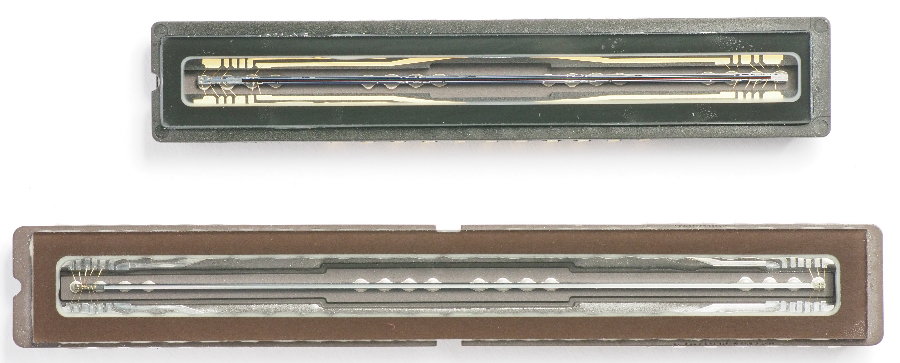
Examples of sensors of film scanners.
Top: sensor of Polaroid Sprintscan 4000 film scanner, with color filters.
Bottom: sensor of Nikon Super Coolscan 8000 ED, not covered with color filters.
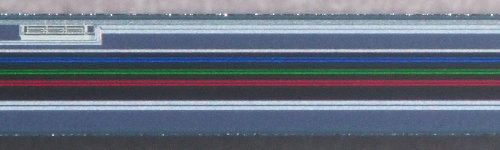
Detail of color filters on sensor of Polaroid Sprintscan 4000 film scanner.
The NIR filter, at bottom on the black background, is visually black.
Most modern film scanners alternately flash red, green, blue and NIR LEDs on each scan line, and record each separate exposure of the scan line with a CCD linear sensor devoid of color filter matrix. Several modern scanners use multi-line linear sensors to scan two or more lines simultaneously. Older scanners used a fluorescent lamp and a CCD sensors with three or four lines (or multiples thereof) of pixels, each overlaid with a built-in color filter (see above picture). Yet older scanners used a fluorescent lamp and a filter wheel, and re-scanned the film frame three or four times, once for each filter.
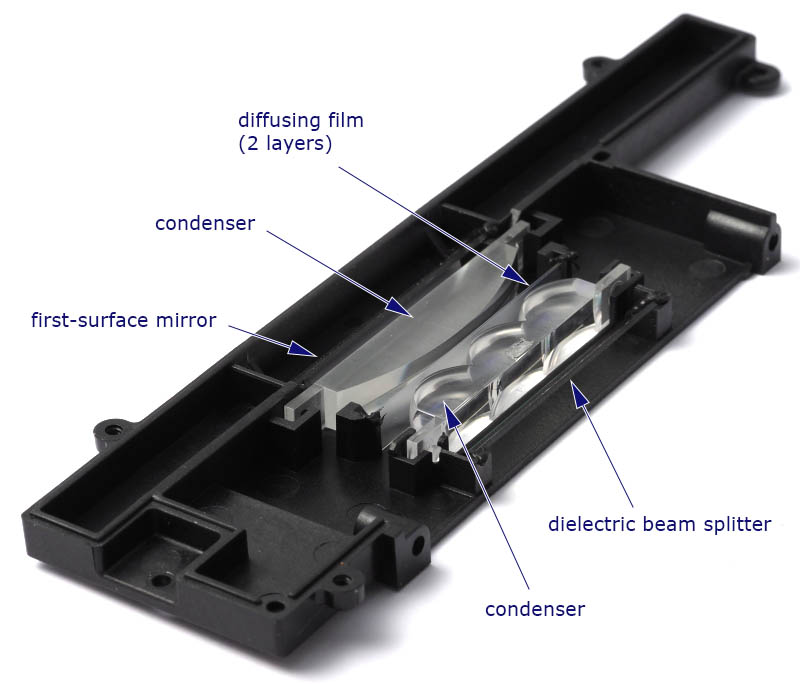
Illumination optics of the Minolta Scan Elite 5400 II scanner.
A final note about scanner technology, more as a technological curiosity than a relevant topic for the use of scanner lenses, is that a variety of optics are used to evenly illuminate the film. Older scanners used a fluorescent tube as light source, which lends itself to the illumination of a long linear subject. More modern scanners use LEDs, which are point-sources of light.
As an example, the above figure shows the illumination optics of the Minolta Scan Elite 5400 II scanner. This scanner uses two rows of four LEDs each, oriented at 90° from each other, and combines the light from the two rows with a dielectric-coated beam splitter. An additional, strongly diffusing plastic sheet (not visible in the above figure) is placed at the exit of the optic train between the first-surface mirror and the film. Why two rows of LEDs? My guess is that one row provides white light for the scanning exposure, the second row NIR light for the dust-detection process. It is also possible that two rows of LEDS are used simply to increase the amount of light, but in this case the LEDs must be a special type that emits NIR together with VIS (e.g. by using a special phosphor that emits also in the NIR). Ordinary white LEDs emit little or no NIR, since this would waste energy and reduce their efficiency in the VIS.
Other scanners use completely different illuminating optics. For example, the Nikon Coolscan 9000 uses a cylindrical light guide illuminated at both ends, with a diffusing white window painted along one side of the light guide to reflect diffuse light out of the light guide perpendicularly to its length.